
Voices from the Forums: Housing, healing and belonging in Dessie
Every night, women in Dessie's collective centres make the same calculation: where is it safe to sleep, where can children rest, and will the roof hold if it rains?
Nearly six years after conflict forced thousands of people from their homes, many families are still living in overcrowded shelters that were never designed for long-term use. Alongside them are Ethiopians returning after migration abroad, internally displaced people unable to return home and vulnerable host communities, all trying to rebuild their lives in a city where housing, livelihoods and public services remain under increasing pressure.
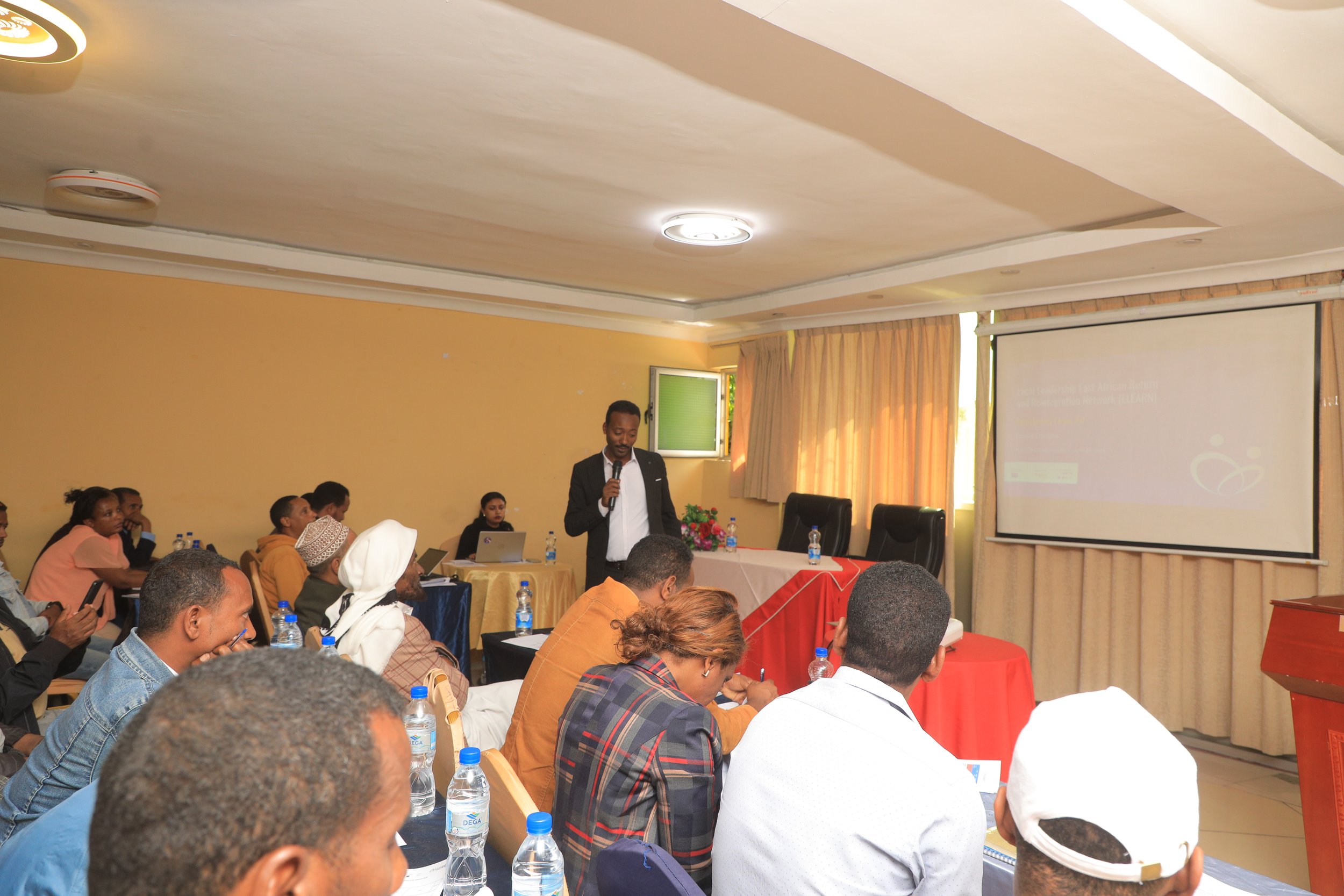
Over the course of three Participatory Forums (PFs) under the LLEARN project, government representatives, humanitarian organisations, civil society, universities, community leaders, service providers, internally displaced people and returnees came together to shape a shared vision for reintegration in Dessie. PF1 identified the city's key reintegration challenges, PF2 developed practical solutions to address them, and PF3 translated those ideas into concrete project pathways for implementation.
Throughout the discussions, one message emerged repeatedly: reintegration is not only about returning or rebuilding infrastructure. It is about restoring dignity, safety and opportunity, particularly for women whose experiences often reveal where systems are failing.
Housing, dignity and healing
For many women, housing is about far more than shelter. It is about privacy, dignity and protection.
Participants described families living for years in overcrowded collective centres where damaged roofs, leaking shelters and the absence of private space increase the risk of gender-based violence and make recovery more difficult.
"There are IDPs where their houses are leaking and overcrowding where there is lack of privacy where women are being assaulted. So shelter maintenance and shelter construction should be given priority. How else can we immediately protect those that face GBV and abuse in Collective Centers?" said Musa Tsegaw from the Development Expertise Center (DEC).
Yet participants argued that improving physical conditions alone will not rebuild lives.
"Mental health and psychosocial support is crosscutting because all of our target groups require it and even the other priority areas should include MHPSS as a component," explained Habiba Shemsu, SGBV Officer at DICAC/RRAD.
Housing can provide safety, but healing requires more than walls and roofs. Participants emphasised that psychosocial support should be embedded throughout reintegration efforts, from shelter programmes to livelihoods, recognising that prolonged displacement, violence and uncertainty continue to shape people's ability to rebuild their lives.
This was especially true for women returning after difficult migration journeys.
"Because if one girl on her way to migrate abroad or her way back gets sexually assaulted and suffers many traumas, then she needs some services upon return. A place that also has referral pathways," said Serkalem Solomon from South Wollo Zone Labour and Skills.
Beyond survival: linking food security with livelihoods
In Dessie, food security underpins every aspect of reintegration. When families are struggling to afford food because of rising prices, inflation and limited incomes, rebuilding livelihoods, accessing education or planning for the future becomes significantly more difficult.
“I can tell you everyone's first worry is what will I eat and feed my children. There are pregnant women who need food. A person cannot think of other things unless they are able to eat and sleep. So food security and shelter is what we want prioritised,” said Awol Yesuf, Degan camp IDPs Representative
"With the market inflation and rise of fuel prices, it is also important to take into consideration the current market and rising prices when giving IDPs cash assistance," noted Mebtu Getahun from Self Help Africa.
The forums challenged the traditional divide between humanitarian assistance and development. Emergency food support remains essential, but on its own it cannot move people beyond prolonged displacement. Instead, participants envisioned a continuum that links immediate assistance with access to productive land, agricultural inputs, skills recognition, finance, market opportunities and decent work. In this way, livelihoods become not a separate priority, but the pathway through which food security can gradually give way to greater self-reliance.
Documentation as a gateway to belonging
Without documentation, people struggle to access employment, financial services, civil registration, education and other essential public services.
For many internally displaced people, this challenge is compounded by the length of their displacement. After years of living in camps, many remain unable to obtain local identification because existing systems do not recognise their prolonged presence in the city.
“One man passed away in an accident, and we couldn’t contact anyone because he didn’t have an ID on him. Five days later, we discovered he was an IDP and didn’t have documentation,” said Inspector Tesfaye Kebede, South Wollo Zone Police
The discussions highlighted that improving documentation requires clearer institutional responsibilities, more accessible registration systems and stronger coordination between local authorities. Participants also explored practical solutions, including support letters through kebele administrations, mobile registration services and digital systems that could better track the needs of internally displaced people and returnees over time.
“Ethiopia is a signatory to International Laws and has National Laws that give all citizens the right to access necessary documentation,” said Yisehak Demissie, South Wollo Zone, CRRSA
From priorities to project pathways
By the third Participatory Forum, the conversation had shifted from understanding challenges to deciding how they could be addressed in practice. Participants refined three interconnected project concepts: Food Security and Safe Shelter, Documentation and Civil Registration, and Sustainable Livelihoods and Mental Health and Psychosocial Support (MHPSS), recognising that each responds to a different stage of the reintegration journey.
One moment captured the spirit of the process. During the first round of voting, Documentation and Civil Registration received the highest number of votes. However, internally displaced people challenged the result, arguing that documentation alone could not address the immediate realities facing families who lacked enough food to eat or a safe place to sleep. After listening to these perspectives, participants agreed to hold a second vote, selecting Food Security and Safe Shelter as the community's immediate priority.
"As someone who is representing IDPs, I can tell you everyone's first worry is what will I eat and feed my children. There are pregnant women who need food. A person cannot think of other things unless they are able to eat and sleep." — IDP Representative, PF3
Following the forum, the consortium reviewed all three concepts against implementation feasibility, partner mandates and the resources available during LLEARN's final phase. While Food Security and Safe Shelter remained the community's most urgent humanitarian priority, Documentation and Civil Registration emerged as the most feasible intervention for LLEARN to implement directly. Building on CEHRO's previous experience and existing government systems, the project will pilot a mobile documentation model that brings national identification services closer to internally displaced people and returnees, reducing cost and distance barriers while improving access to education, financial services, healthcare, employment and other public services.
The discussions reinforced several broader lessons for reintegration in Dessie:
Food Security and Safe Shelter remain the immediate humanitarian priorities for protecting dignity, safety and wellbeing, particularly for households experiencing prolonged displacement.
Documentation is the enabling infrastructure for reintegration, opening pathways to banking, education, healthcare, employment and civic participation, and will form LLEARN's Phase 3 pilot.
Livelihoods and MHPSS remain essential recovery pathways, helping people move from survival towards self-reliance while recognising that economic recovery and psychosocial wellbeing are inseparable.
Reintegration depends on collaboration, requiring government institutions, humanitarian organisations, civil society and communities to work together rather than in parallel.
"There should be a single entity with a clear mandate to address IDP issues, ensuring coordination among sectors." — Yirga Demeke, Public Prosecutor
The participatory process itself became one of the strongest outcomes of the forums. By challenging the initial vote and ensuring that lived experience shaped the final community priority, participants demonstrated that meaningful participation is not simply about being present in the room. At the same time, the transition from community priorities to a feasible implementation model showed how locally identified needs, institutional mandates and available resources can be brought together to produce practical action. This is what the LLEARN project is all about.
Watch interviews and videos from the forum here.