
From listening to action: Three lessons on locally led reintegration from LLEARN
"The solution is only sustainable when everybody is included."
- Mesud. G Reta (CEHRO, Ethiopia)
Across Africa, displacement continues to grow despite important advances in policy and practice. According to the Internal Displacement Monitoring Centre (IDMC), 35 million people were living in internal displacement across the continent at the end of 2023 — nearly half of the global total, and three times as many as in 2009.
This does not mean that nothing has worked. African governments have developed important legal and policy frameworks, including the landmark Kampala Convention, and communities, municipalities, civil society organisations and humanitarian and development actors have built responses across the continent. But the scale and persistence of displacement point to a continuing challenge: how can responses move beyond managing displacement towards creating the conditions for people to rebuild their lives, participate in their communities and shape their own futures?
This is one of the questions at the heart of the Local Leadership East African Return and Reintegration Network (LLEARN).
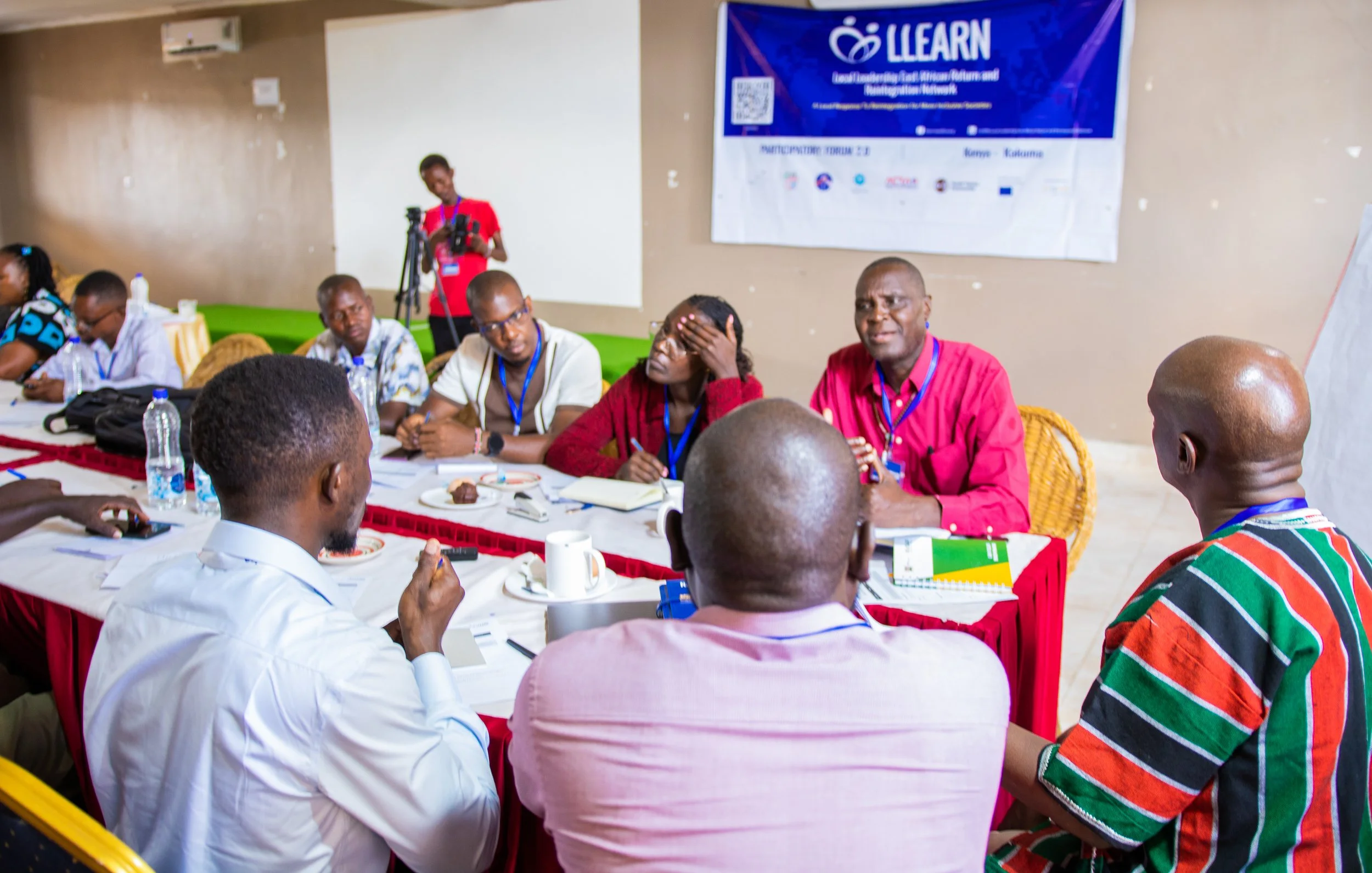
Its approach starts with evidence, but it does not end there. Research findings are brought into Participatory Urban Planning Forums where refugees, returnees, internally displaced people, host communities, municipal authorities, civil society, private sector actors and others can question the evidence, identify priorities and progressively co-design responses.
At a two-day LLEARN consortium gathering in Nairobi on 29-30 June 2026, partners from across the five countries compared what they were seeing and hearing in their different contexts. The challenges varied enormously. Yet three lessons kept coming back.
1. Data is the starting point - communities help us understand what it actually means
One of the clearest reflections came from Mesud G. Reta from Ethiopia:
“Everyone has ideas. Everyone has a solution. But what we are lacking is space.”
That idea captures something fundamental about LLEARN. Participation does not mean arriving with a predetermined solution and asking communities whether they agree with it. It means creating spaces in which evidence itself can be questioned, interpreted and improved through lived experience.
We have seen this across the five cities.
In Bosaso, Somalia, participants challenged the way economic vulnerability was being interpreted. They did not dispute that displaced households faced hardship. They challenged the assumption that economic vulnerability meant people were not working. Participants described IDPs working in construction, port labour, fishing, sanitation, cleaning and petty trade. The underlying issue was not simply unemployment, but irregular work, low returns and limited pathways towards economic stability.
In Dessie, Ethiopia, participants similarly challenged what counts as “access” to housing. If a household is living for years in an emergency shelter that leaks during the rainy season, can this really be recorded as adequate housing? Their interventions changed the interpretation of the data by bringing lived experience back into the analysis.
And in Koboko, Uganda, discussions complicated a simple unemployment narrative. Refugees and returnees were already farming, trading, apprenticing and running small businesses. What constrained them were unstable markets, limited capital, documentation barriers and difficulties formalising businesses.
The regional lesson is important: good evidence is not only evidence collected from communities. It is evidence that communities have the opportunity to interrogate, contextualise and use.
2. Inclusion is not simply about who is invited - it is about who can shape the decisions
From Somalia, Ibrahim Abdullahi Mohamed reflected on how unusual it was to have groups such as IDPs, host communities, government and the private sector discussing displacement together.
That matters because reintegration rarely falls neatly within the mandate of one institution.
In Bosaso, more than 50 participants brought together municipal authorities, community representatives, women and youth, religious leaders, returnees, IDPs, migrants, minority groups, private sector actors and humanitarian organisations. The discussions exposed both the city's strong narrative of openness and the much more precarious reality of people living with insecure land tenure, weak shelter and inadequate sanitation.
In Koboko, refugee-led organisations sat alongside municipal and district officials, health actors, immigration and police representatives, market actors, women and youth leaders and the private sector. Participants described a town where refugees and hosts already share schools, health facilities, markets and neighbourhoods — but where formal participation and economic opportunities do not always reflect that everyday coexistence.
And in Kakuma/Kalobeyei, where a long-standing refugee-hosting area is undergoing a transition towards municipal governance, the question of participation became even more explicit, the question of participation became even more explicit: if refugees are expected to become part of a municipality, what meaningful role will they have in shaping how that municipality develops?
Putting different actors in one room does not automatically eliminate existing inequalities or power relations. It requires deliberate facilitation, accessible language, smaller discussion spaces and attention to whose voices dominate and whose are missing.
But when it works, something important changes. Communities are no longer simply being consulted about decisions made elsewhere. Municipal authorities are no longer expected to solve problems alone. Civil society, displaced communities, service providers and private actors begin to see where their responsibilities and interests intersect.
Inclusion becomes meaningful when presence turns into influence.
3. The conversation is just the first step to a long road – it has to lead somewhere
Reintegration cannot be reduced to one livelihood programme, one training course or one service intervention. Whether people can rebuild their lives depends on the systems around them: land, documentation, markets, schools, health services, municipal planning, participation and the informal networks through which people navigate everyday life. That is also why participants repeatedly stressed that dialogue cannot be the endpoint.
“We want to see that this is not just a conversation.”
This concern is understandable. Communities have participated in workshops before. They have been consulted, studied and asked to identify priorities. The real test is what happens after the meeting ends.
LLEARN's Participatory Forum process is designed around that challenge. The first stage starts with data: participants interrogate the evidence, validate lived realities and build consensus around priority issues, stakeholders and areas for action. Subsequent forums progressively move from those priorities towards co-created project concepts, clearer stakeholder roles and implementable plans. The process then leads into validation, where commitments can be shared, clarified and tracked.
Over the next three months, the LLEARN team will work across all five cities to take co-designed priorities into implementation through locally developed projects and partnerships. The objective is therefore not participation for its own sake. It is participation that can influence planning, partnerships, investment and implementation.
From dialogue to action
Perhaps the most important regional lesson emerging from LLEARN is that there will never be one reintegration solution that can simply be copied from one city to another.
Bosaso is not Aweil. Kakuma/Kalobeyei is not Koboko. Dessie brings yet another combination of displacement and return trajectories. Each city has different institutions, histories, economic opportunities and relationships between displaced and host populations.
What can travel between them is not a fixed solution, but an approach — and a network through which cities and practitioners can learn from one another.
Start with evidence. Put that evidence into the hands of the people who live the reality it describes. Bring together those with lived experience, those with formal authority, and those with the resources, networks or influence to act. Create enough space for disagreement and learning. Then turn shared priorities into plans, partnerships and commitments. That is a slower but more inclusive process than arriving with ready-made answers.
If reintegration is ultimately about people rebuilding lives within communities and cities, then the people who live in those places cannot remain at the edge of the decisions that shape them.
As the opening quote reminded us: the solution is only sustainable when everybody is included.
Authored by Roman Karsenti